The NoSeMaze is a semi-naturalistic, open-source platform that continuously tracks reinforcement learning, social rank, chasing, and full social-interaction networks in group-housed mice — 24/7, without human interference. Hardware, control software, and analysis code are fully open.
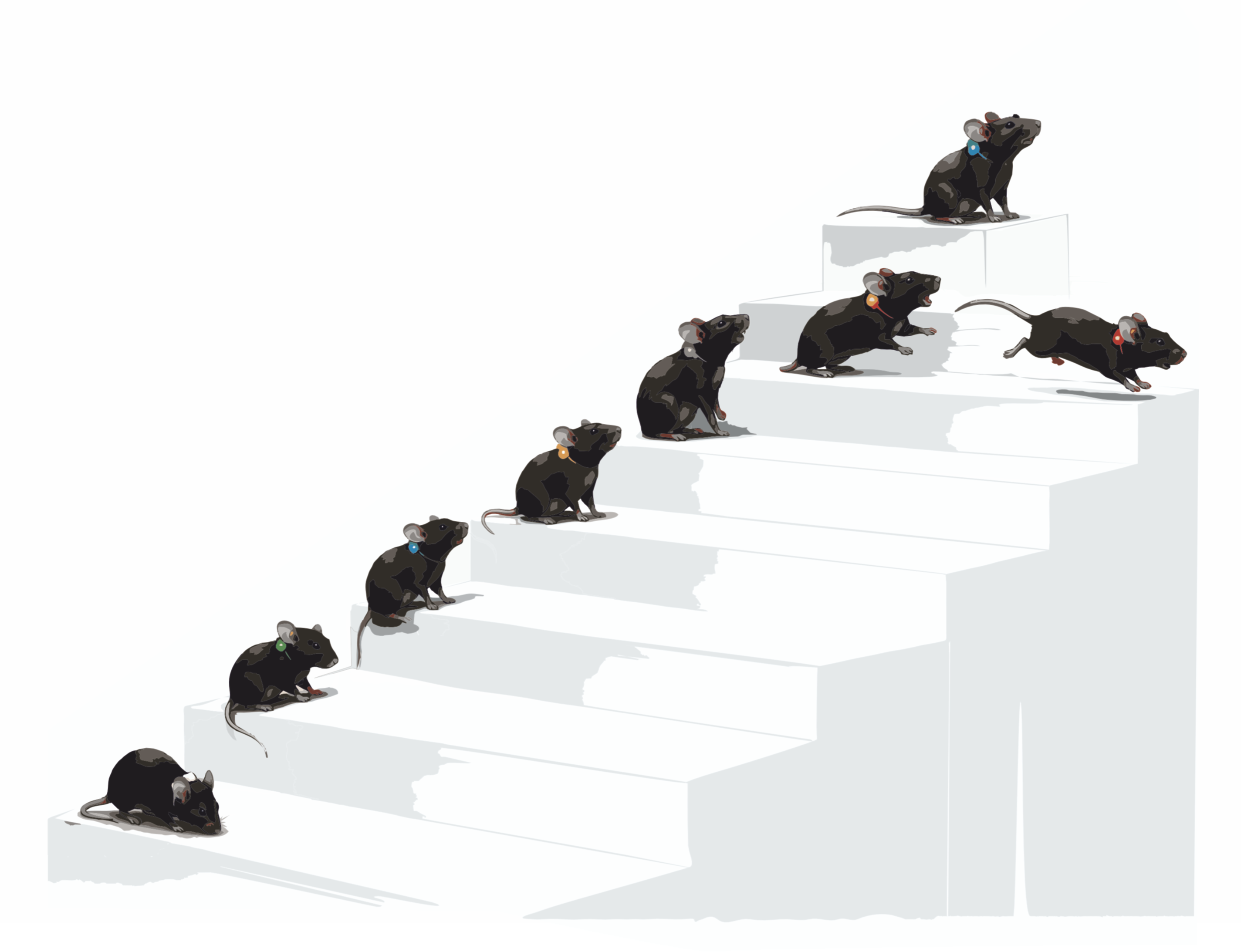
The NoSeMaze is a complex, semi-naturalistic environment for the fully automated, long-term study of mouse societies. Groups of 9–12 mice live in it undisturbed for weeks while the system continuously records how they learn, compete, and interact. Because social and cognitive behaviours are captured in parallel, in the same individuals, the NoSeMaze can ask how these domains relate. The option of systematic group reshuffling then allows systematic testing of whether an individual's traits are stable across changing social contexts. It builds on and extends the open-source AutonoMouse platform (Erskine et al., 2019).
Animals are undisturbed; behaviour is self-paced and ecologically valid.
Learning, hierarchy, chasing, and interaction networks from one system.
Weeks-long rounds with changing group composition separate stable traits from context.
Open hardware documentation, control software, and analysis code.
Two connected spaces, joined by two tubes with RFID readers. Water is earned only at the olfactory learning module. Because mice must cross the tubes to reach food and water, the everyday act of living in the maze generates exactly the events we measure — no staged tests, no handling.
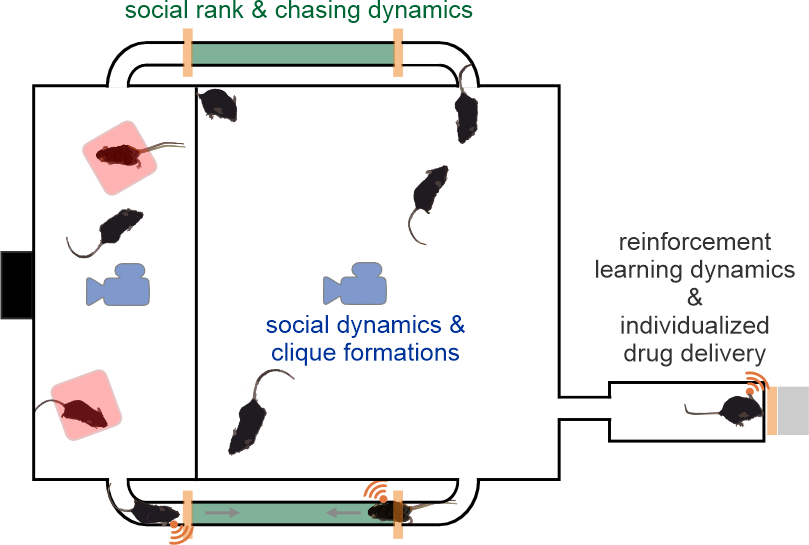
Individual ID on every passage → tube competitions (rank) + chasing.
social rank · agonistic behaviourVideo tracking → interaction & directed-approach networks, and the higher-order social structures they form.
interaction & approach networksRFID-gated go/no-go trials → reinforcement-learning profiles.
learning · impulsivity · flexibilityNesting + food; the “home” end of the loop that drives tube crossings.
drives the daily trafficThe NoSeMaze yields measurements across four behavioural pillars — reinforcement learning, competition-based social rank, chasing, and video-based social networks — and, crucially, resolves the higher-order social structures that groups form and how these evolve over time. Each measure has been established and validated in peer-reviewed work.
| Domain | What it captures | Key validated metrics | Study |
|---|---|---|---|
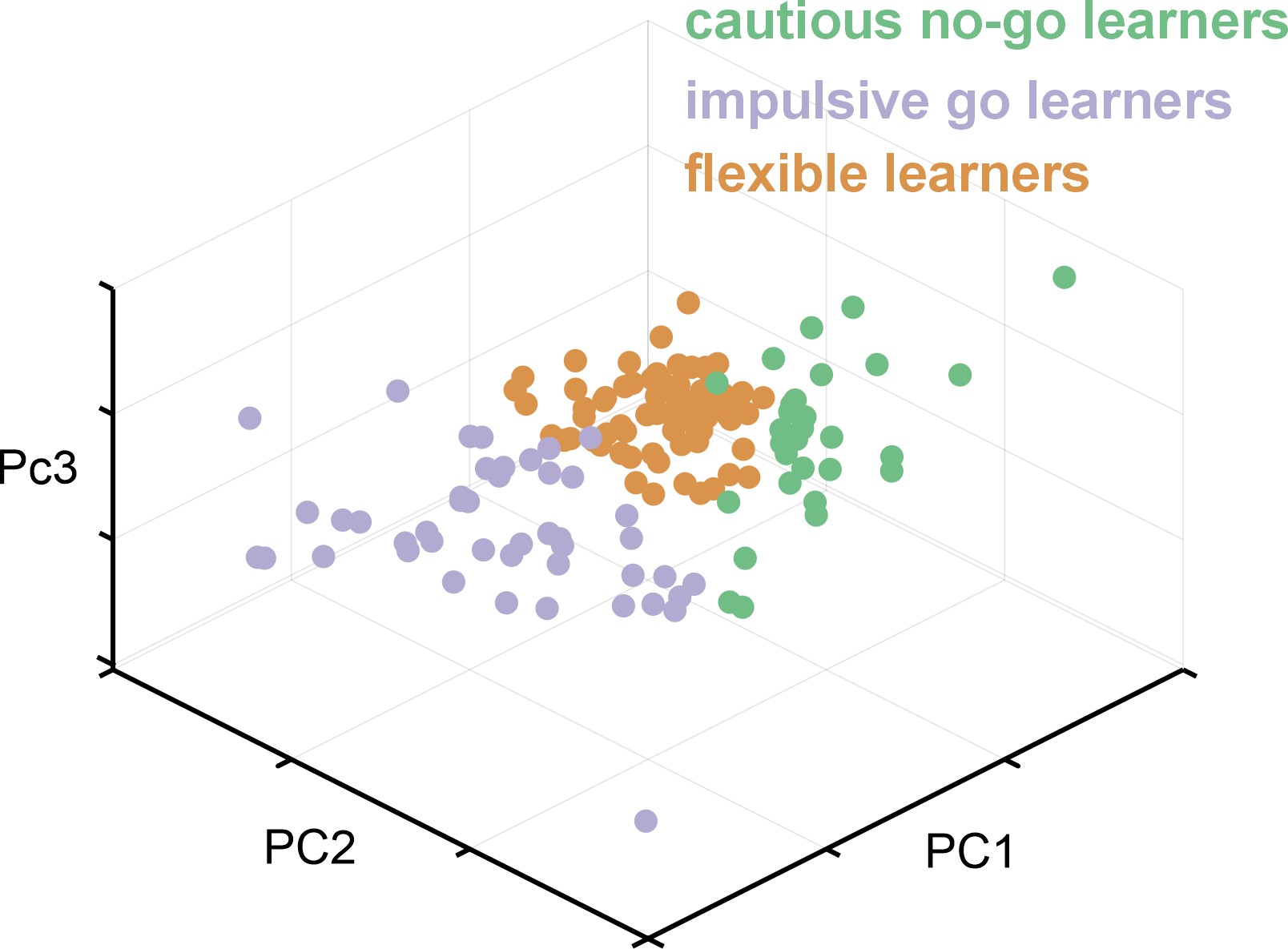
| Reinforcement learning & cognition | Self-initiated go/no-go olfactory learning at the water port | Correct hit / rejection rates; pre-CS licking (impulsivity); CS+ modulation (reward sensitivity); CS+/CS− switch latencies (flexibility); time-to-criterion → three learning strategies | Reinwald |
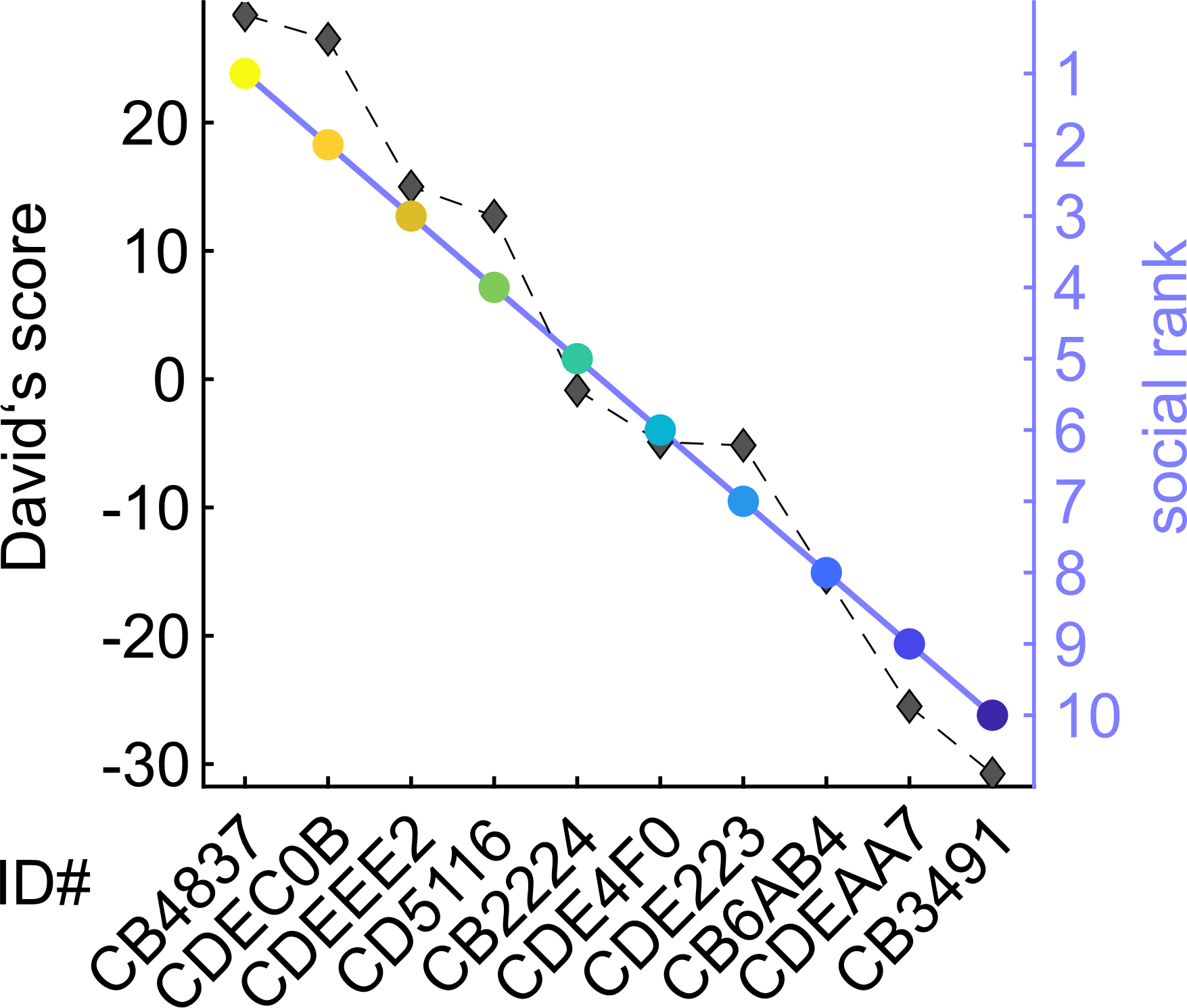
| Social hierarchy & rank | Incidental tube competitions | David's score → linear ranks; Elo rating; hierarchy transitivity, steepness, stability, uncertainty-by-repeatability (convergent & temporally stable; validated vs manual tube test) | Reinwald |
| Chasing (agonistic) | Voluntary tube chasing | Fraction of chases initiated / received; concentrated in a few individuals; stable within & across rounds | Reinwald |
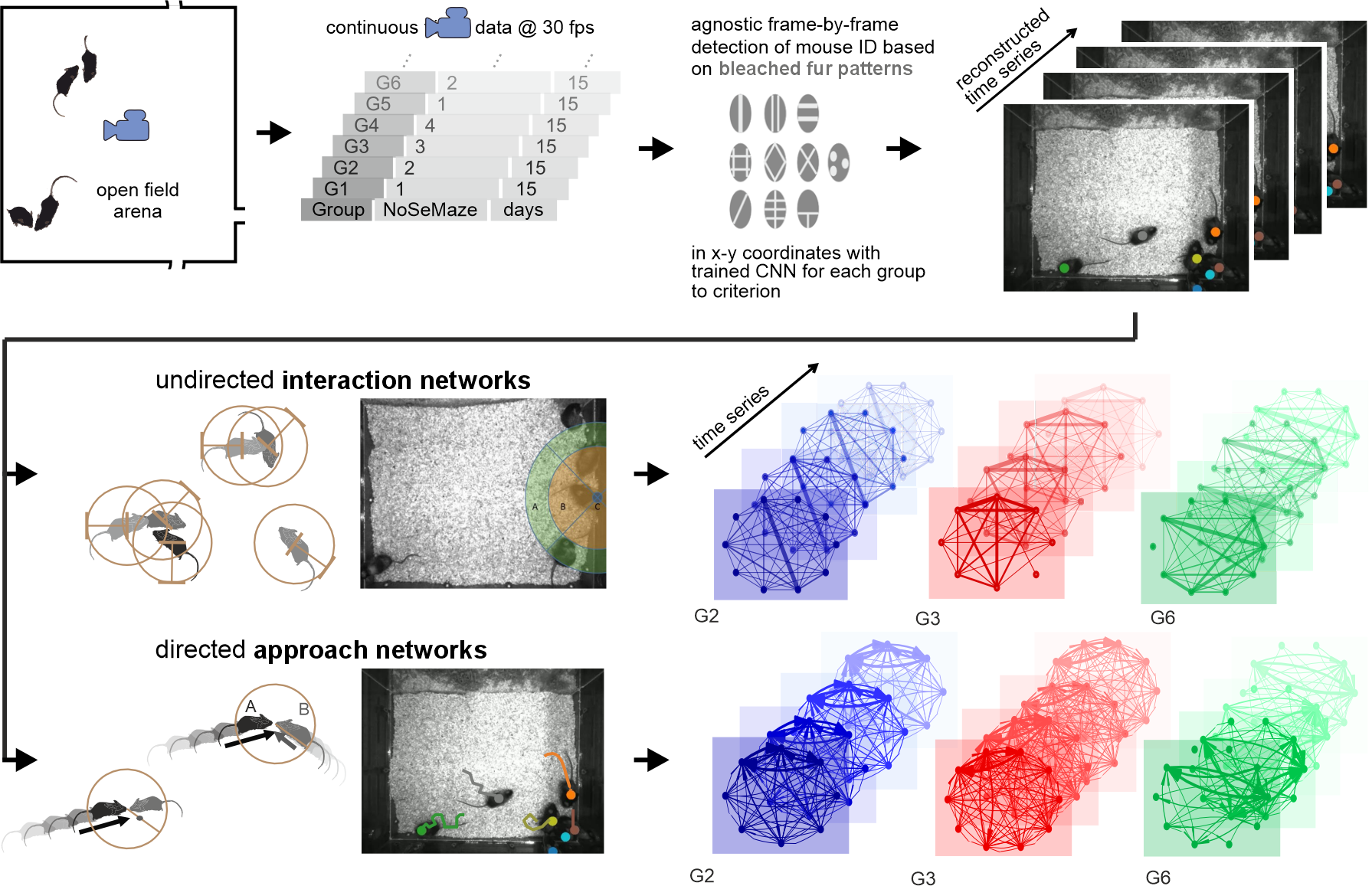
| Social-interaction networks | Overhead video of the open arena | Undirected interaction networks; directed approach networks; interaction-time networks (proximity <10 cm ≥1 s; directional approaches) | Nelias |
| Higher-order structure: rich-clubs | Network substructure over time | Mutual k-NN pruning; normalized weighted rich-club coefficient; stable rich-club (sRC) membership; null-model / permutation testing; reciprocity | Nelias |
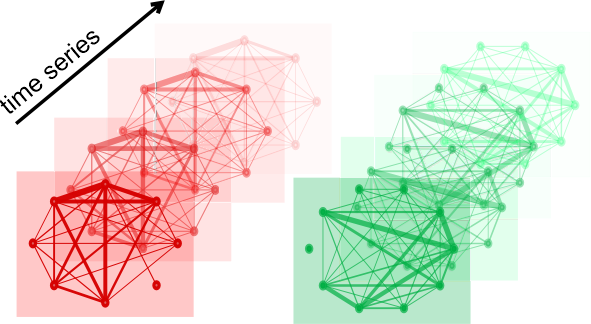
| Temporal network dynamics | How consistently ties are maintained | Mean Normalized Edge Fluctuation (NEF, novel); out-strength; incoming vs outgoing | Nelias · new |
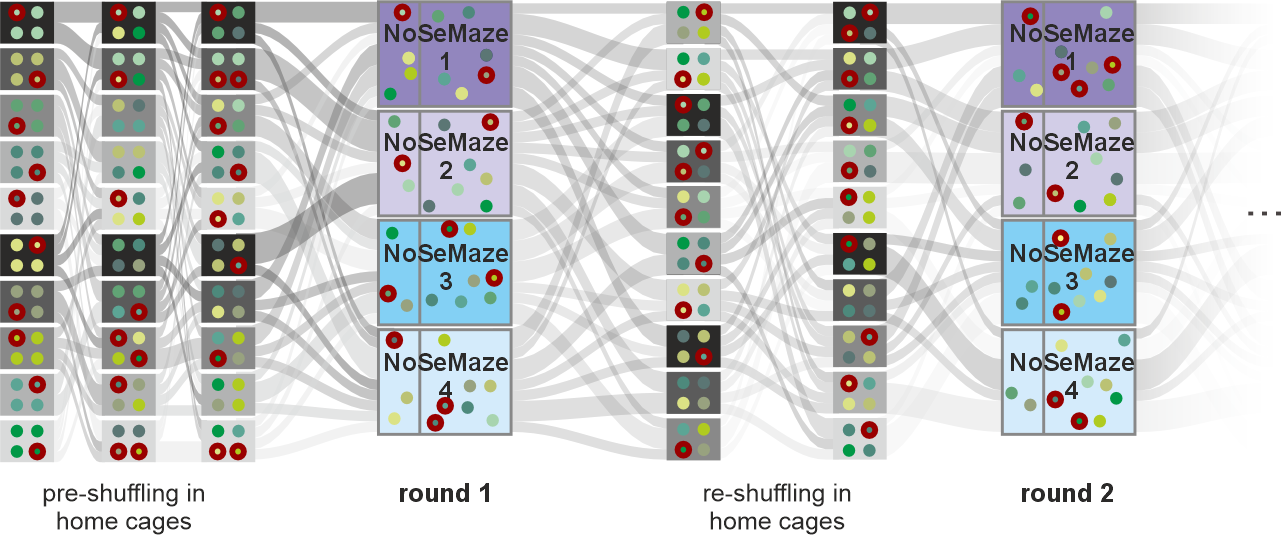
| Trait stability across contexts | Reshuffled group composition across rounds | Between-round Spearman ρ; intraclass correlation (ICC); strategy-consistency (Sankey) | both |
Detail Jump to the detailed measures ↓
Clustering on the reward-seeking features separates impulsive go-learners, cautious no-go learners, and flexible learners. These strategies are largely retained when an animal is placed into a new group — a tangible, individual-level cognitive fingerprint from a self-paced task.
Beyond pairwise contacts, the video networks resolve the higher-order social structures a group forms: small, stable, mutually-interacting cliques (“rich-clubs”) emerge in most groups. Members are higher-ranked and more reciprocal, membership arises de novo from group dynamics rather than kinship, and it can be disrupted by a targeted sensory manipulation. A novel measure — the Mean Normalized Edge Fluctuation (NEF) — captures how these relationships change over time, distinguishing steady from erratic social ties.
Because rank, chasing, cognition, and network role are all measured in the same animals, the platform supports linking them — for example, relating rich-club membership to social rank and chasing. This cross-domain view within one continuous dataset is the platform's differentiator.
Every domain above is backed by convergent validation, null-model testing, and cross-round stability analysis — the measures reflect genuine biology, not tracking artefacts.
Analysis code Social-status (Reinwald) · Rich-clubs & NEF (Nelias) · TempNetViz — temporal-network viewer
Three core modules, connected to one control computer. RFID individual identification runs through all of them.
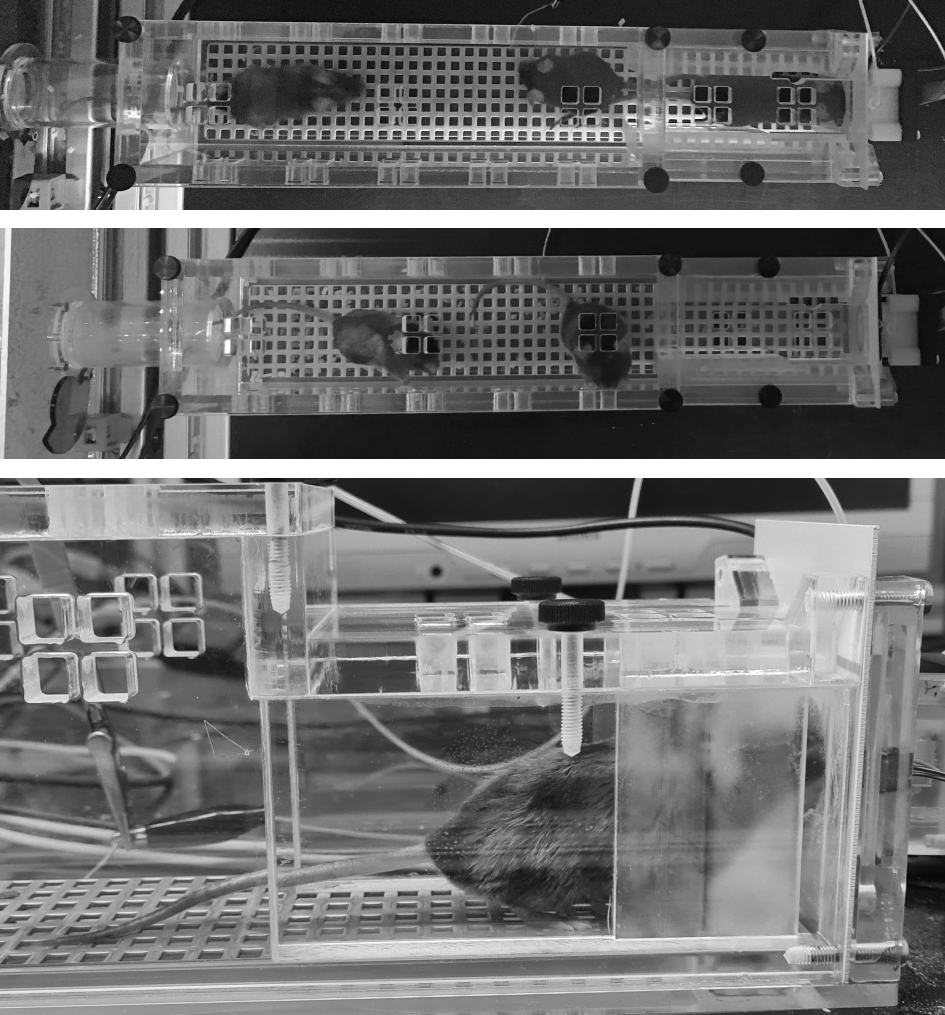
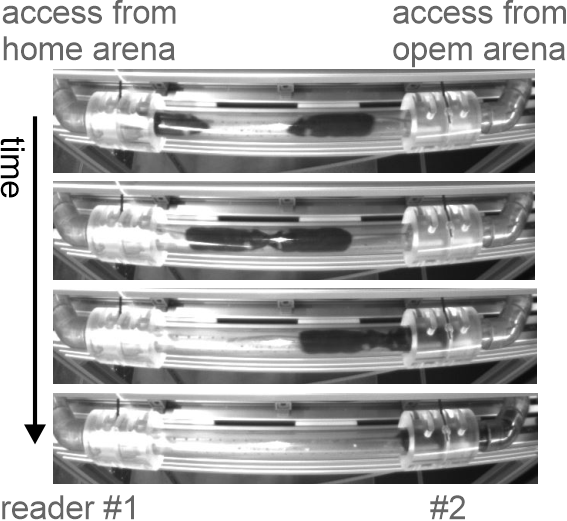
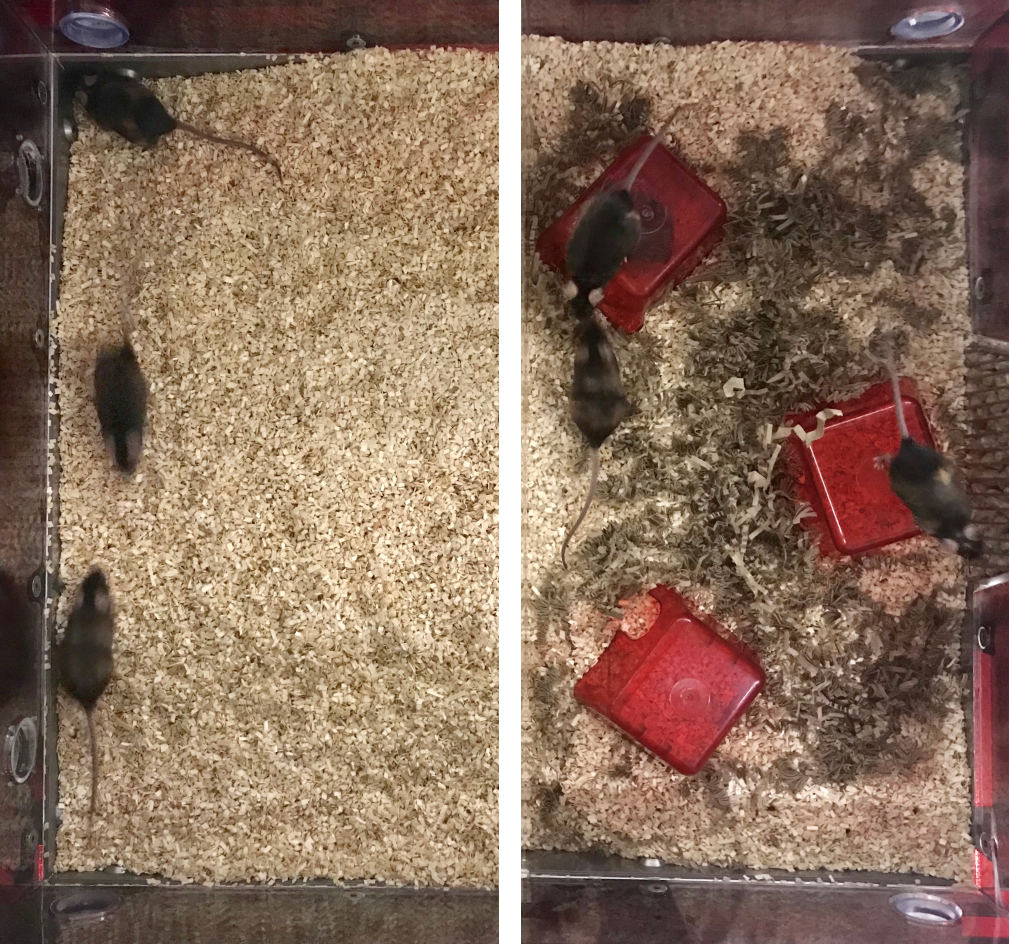
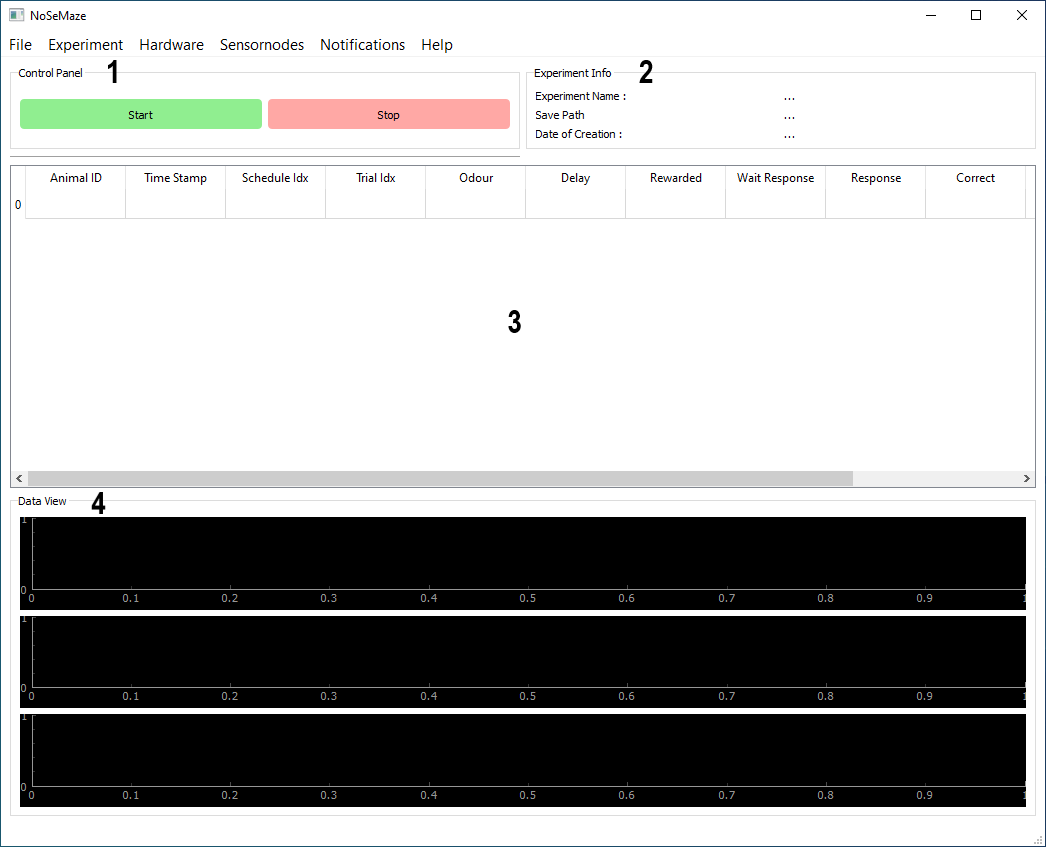
All modules connect to a single computer running NoSeMazeControl, an open-source Python application that plans experiments, runs them, and stores the data. Its interface lets you design the olfactory task and build trial schedules (the former NoSeMazeSchedule tools are now integrated as tabs). RFID detections trigger the task logic and tag every event to an individual.
main.py from source or use the prebuilt .exe.Links Control software · User guide
Establishes the platform and validates reinforcement-learning profiles, tube-competition social rank, and chasing — and shows these are stable individual traits across reshuffled groups (>4,000 mouse-days, 21 rounds).
Establishes the video-based social-network pipeline and validates rich-clubs, stable rich-club membership, and temporal edge dynamics (NEF) — 7,200 hours of continuous video.
The core repository holds the control software and the full hardware and setup documentation; two companion repositories contain the analysis code behind the studies; and a dedicated tool visualises the temporal social networks. The system extends the open-source AutonoMouse project.
Core. Control software (NoSeMazeControl) + hardware reference, wiring, setup & user guides.
Open repository →Analysis scripts (MATLAB & R) for social rank, chasing, reinforcement learning and stability (Reinwald et al.).
Open repository →Python code for social networks, rich-clubs, NEF and null-model testing (Nelias et al.).
Open repository →GUI for visualising temporal graphs — pairs naturally with the network analyses.
Open repository →See the parts list and specs.
Follow the habitat setup & wiring guide.
Python 3.10+ or the .exe; design your task.
9–12 mice, weeks-long, unattended.
Use the published analysis repositories.